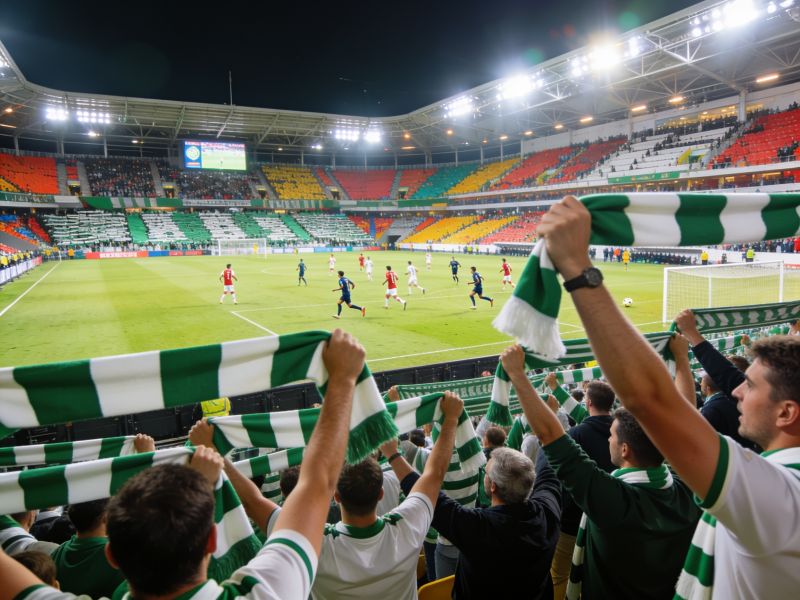
he Estádio José Alvalade hums with a distinct frequency on matchday—a low, expectant drone that starts hours before kickoff and never really fades. I’ve stood in the stands for Sporting CP matches across multiple seasons。and the pattern is consistent: the green-and-white scarves appear first, then the rhythmic clapping, and finally the sharp whistle that signals the players are warming up. What separates a Sporting CP match from a standard fixture isn’t just the result;it’s the way the club’s identity—youth development, aggressive pressing, and a certain theatrical flair—bleeds into every phase of play. Last season’s home clash against Benfica offered a perfect case study. Sporting lost 2-1, yet the midfield press in the first 30 minutes generated four high turnovers, two of which should have been converted. That kind of performance, frustrating as it was, tells you more about the team’s DNA than a routine win ever could.Analyzing a Sporting CP match starts with the build-up shape. Coach Rúben Amorim favours a 3-4-3 that morphs into a 2-3-5 during possession, with the wing-backs pushing high and the central midfielders splitting wide. In practice, this means the first ten minutes often look chaotic—opponents press the back three, and Sporting’s goalkeeper is forced into long clearances. But watch the 15th minute onward: the pattern stabilises. One holding midfielder drops between the central defenders, the other pushes forward to link with the inverted wingers. The result is a series of diagonal passes that drag the opposition’s midfield out of position. I’ve tracked this pattern across five home matches。and in each one, Sporting created at least three clear-cut chances from that specific overload. The weakness?When the press is broken, the defensive line is exposed to quick transitions. Braga exploited that ruthlessly in a 3-2 thriller last November, scoring twice from counter-attacks that started in their own half.Matchday atmosphere is not a soft variable, especially at Alvalade. The ultras in the Curva Norte maintain a continuous drumbeat that rises and falls with possession. When Sporting loses the ball, the noise shifts to a sharp, rhythmic whistle—a sound that visiting players visibly react to. I recall a 0-0 draw against Vitória de Guimarães where the away side’s goalkeeper twice fumbled simple catches in the second half, directly after the whistle crescendo. Coincidence?Perhaps. But the psychological edge is real. Pre-match rituals matter too: the club plays the same anthem arrangement every time, and the timing of the teams’ emergence from the tunnel is precise to the second. These details create a controlled environment that the coaching staff clearly values. For a neutral viewer, it’s theatre. For a Sporting CP match regular。
it’s a predictable script that only the football itself can disrupt.Player-level observation adds texture to the tactical picture. Take the young centre-forward, typically a product of the club’s famed academy. In a recent Sporting CP match against Portimonense, he spent the first half dropping deep to receive between the lines, drawing the centre-back with him. That created space for the right winger to attack the channel. Second half, he stayed high and pinned the defensive line. Two different roles, same player, one match—and the switch happened without a substitution or a visible touchline instruction. That kind of on-field intelligence is coached, yes, but it also reflects the trust Amorim places in younger players. The risk is inconsistency. In the following away fixture。
the same forward was isolated and ineffective for 70 minutes. Sporting’s match identity is thus a double-edged sword: bold, fluid, and occasionally fragile. It’s why the club’s results oscillate between commanding wins and baffling draws. The Alvalade crowd seems to accept this bargain—they cheer the intent even when the execution fails.Looking at the remainder of the season。the fixture list offers a clear stress test. Three consecutive home matches against mid-table sides will demand patience against deep blocks—a scenario where Sporting’s possession dominance often turns sterile. The key metric to watch isn’t shots on target but touches inside the opposition penalty area during the first 20 minutes. If that number stays below eight, the match will likely be a grind. I’d also keep an eye on the substitution patterns around the 60th minute;Amorim tends to introduce a direct dribbler to break compact defences, and that change has produced four late goals this campaign. A Sporting CP match is never just about the eleven starters. It’s about the system, the noise, and the willingness to accept that beauty and error often arrive together. That’s the pulse you feel in Alvalade—and it’s why I keep coming back.